Why Armilar invested in DOJO AI... and a few insights on why general-purpose AI alone cannot fix marketing

Marketing has never had more data, more tools, or more AI. And yet marketing teams have never felt more overwhelmed.
That is not a paradox. It is a symptom. And explaining it is the starting point for understanding what DOJO AI was built to do.
Revenue growth remains the top priority for CMOs in 2026. But when asked what the top challenge is, 63% cite budget and resource constraints. Marketing budgets as a share of revenue have declined from 11% to 7.7% over the last five years, according to Gartner’s CMO Spend Survey.
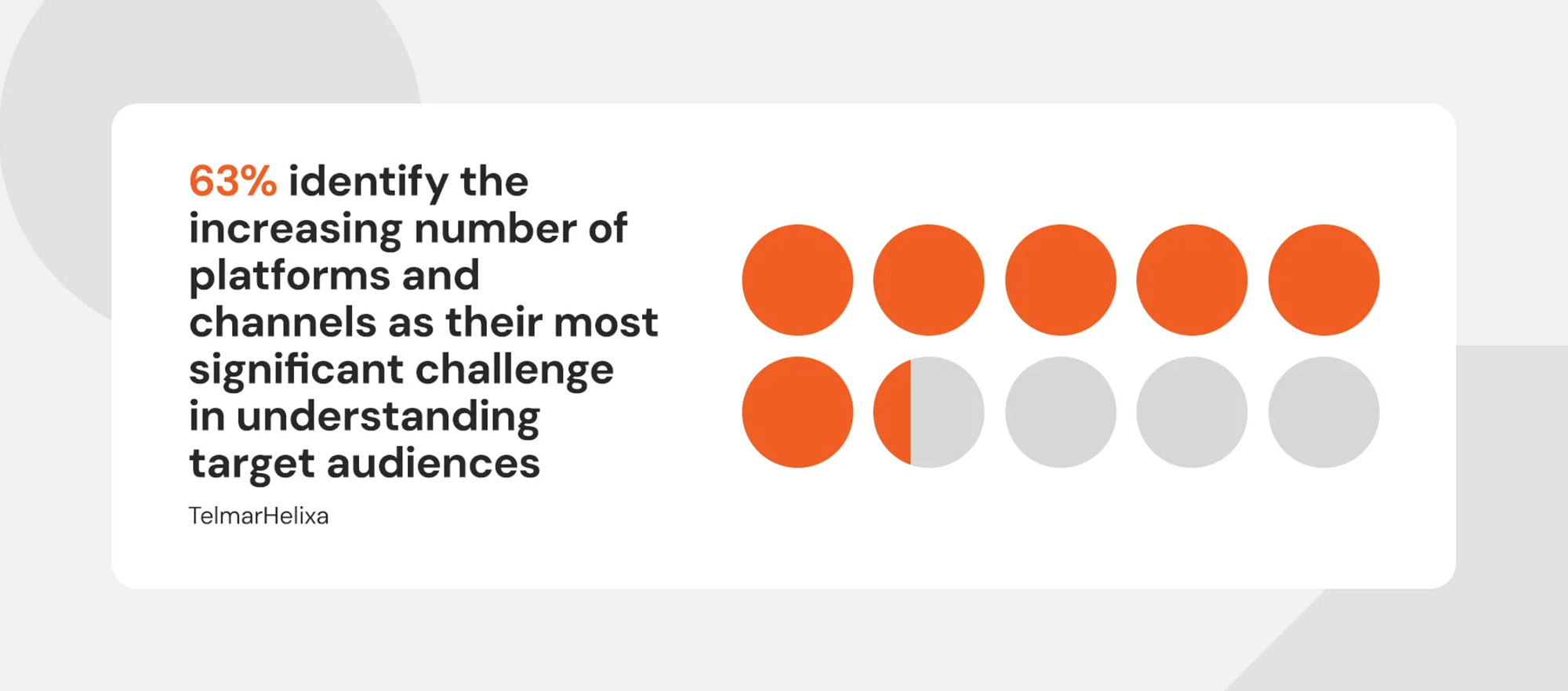
At the same time, the number of channels marketers are expected to master has grown relentlessly. Customer attention has fragmented across TikTok, LinkedIn, YouTube, Instagram, and now across AI-native surfaces like Google AI Overviews and ChatGPT, each demanding its own strategy, its own metrics, and its own specialist knowledge. Each channel has also become increasingly competitive, leading to media spending inflation.
Marketing departments are being asked to do more, with less. The data is everywhere. The tools are multiplying. And somehow, the signal keeps getting harder to find.
More channels, more tools, more work — and data everywhere
In the early 2010s, a comprehensive digital marketing strategy could reasonably cover two major platforms: Google and Facebook. Today, that map looks entirely different. User attention is fragmented. TikTok, LinkedIn, X, Instagram, Amazon, YouTube, Google Search: each is a distinct channel with its own logic, its own algorithm, and its own specialist playbook.
And it does not stop there. Generative AI is adding entirely new categories. Answer Engine Optimisation (AEO), targeting Google AI Overviews, and Generative Engine Optimisation (GEO), targeting ChatGPT, Perplexity, and similar platforms, are now channels that marketing teams are expected to master and measure.
The tooling followed the channels, and did so at an extraordinary pace. In 2011, there were 150 marketing technology solutions. By 2016, 3,800. By 2020, over 8,000. Today, more than 15,000 and still growing.

The logic behind the growth was straightforward: every new channel created demand for a new category of specialised tools — scheduling, listening, automation, keyword tracking, ranking, auditing. Each category stratified rapidly into best-in-breed competitors. Organisations responded rationally: they bought the best tool for each job.
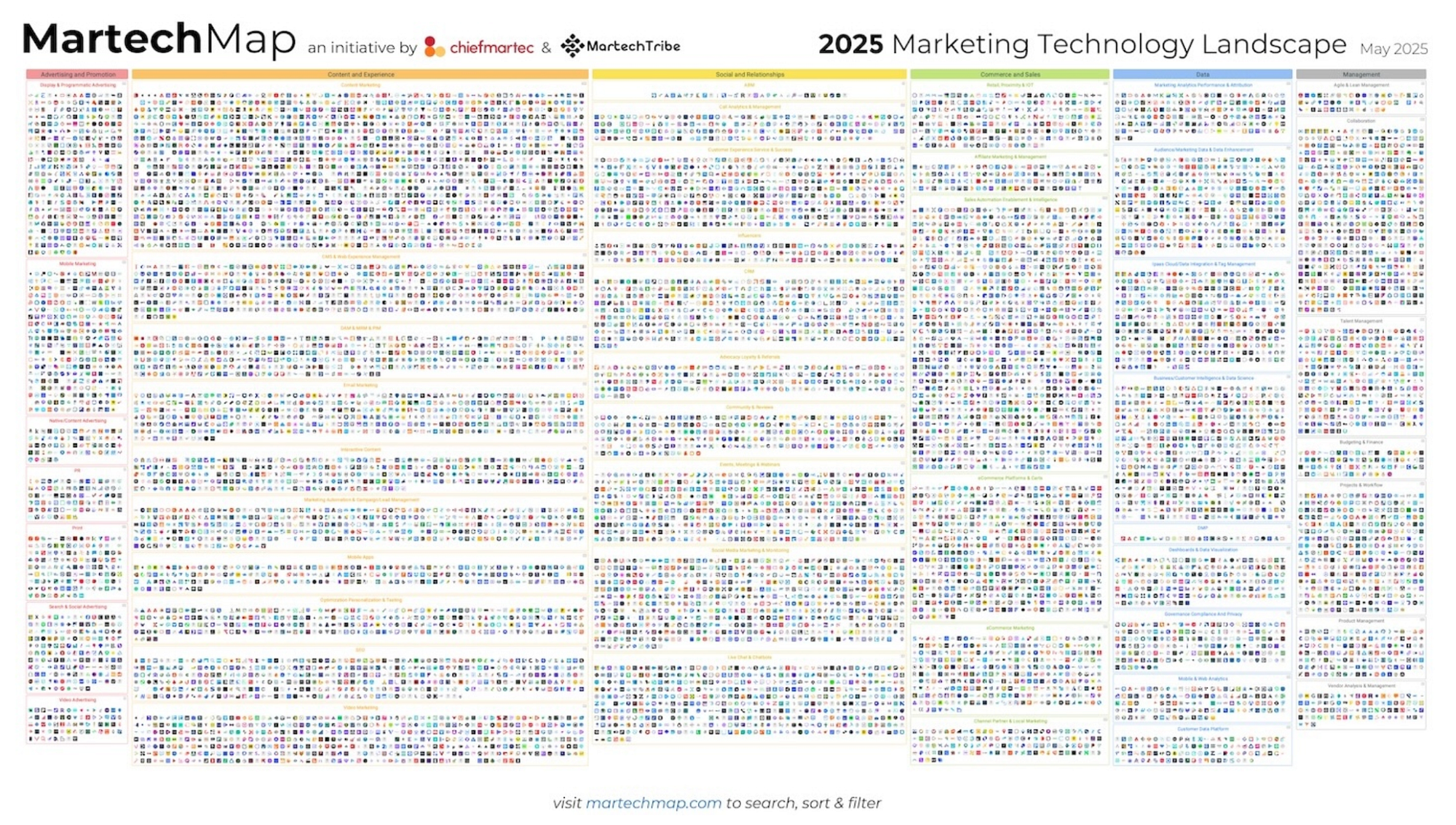
The cumulative result, however, is a marketing stack of extraordinary complexity and cost. Tooling alone now represents over 20% of the total marketing budget, in a total MarTech industry worth over $500 billion. And that figure does not include the cost of the people required to operate those tools.
While channels are distinct, they are not independent. A user might discover a product on TikTok, research it on ChatGPT, and purchase on Amazon. Marketing teams must therefore coordinate actions across channels. Google Ads keywords inform SEO strategy. SEO strategy informs content decisions. Content decisions inform social messaging. The interdependencies are real and consequential.
But the tools managing each channel were not built to talk to one another. Google Ads provides data on paid search. Google Search Console provides organic search data. Google Analytics provides website data. LinkedIn provides its own social and advertising data. Each channel and tool generates data. None of them connect.
In practice, that leaves marketing teams doing the heavy lifting: integrating, analysing, coordinating, and acting across dozens of disconnected solutions.
Complex channels that never stand still
Each channel is also increasingly complex to manage, particularly as they mature and competition intensifies.
Marketers compete for users’ attention against other companies. As competition increases, channels develop new ways to segment their audiences, creating increasingly sophisticated algorithms to optimise for.
To understand just how complex channel optimisation has become, every major ad platform now presents an astronomical scale of choices, with advertisers navigating billions of potential data points and configuration decisions. The result is that most campaign configuration decisions, on all major platforms, every day, are made on instinct, habit, and incomplete data.
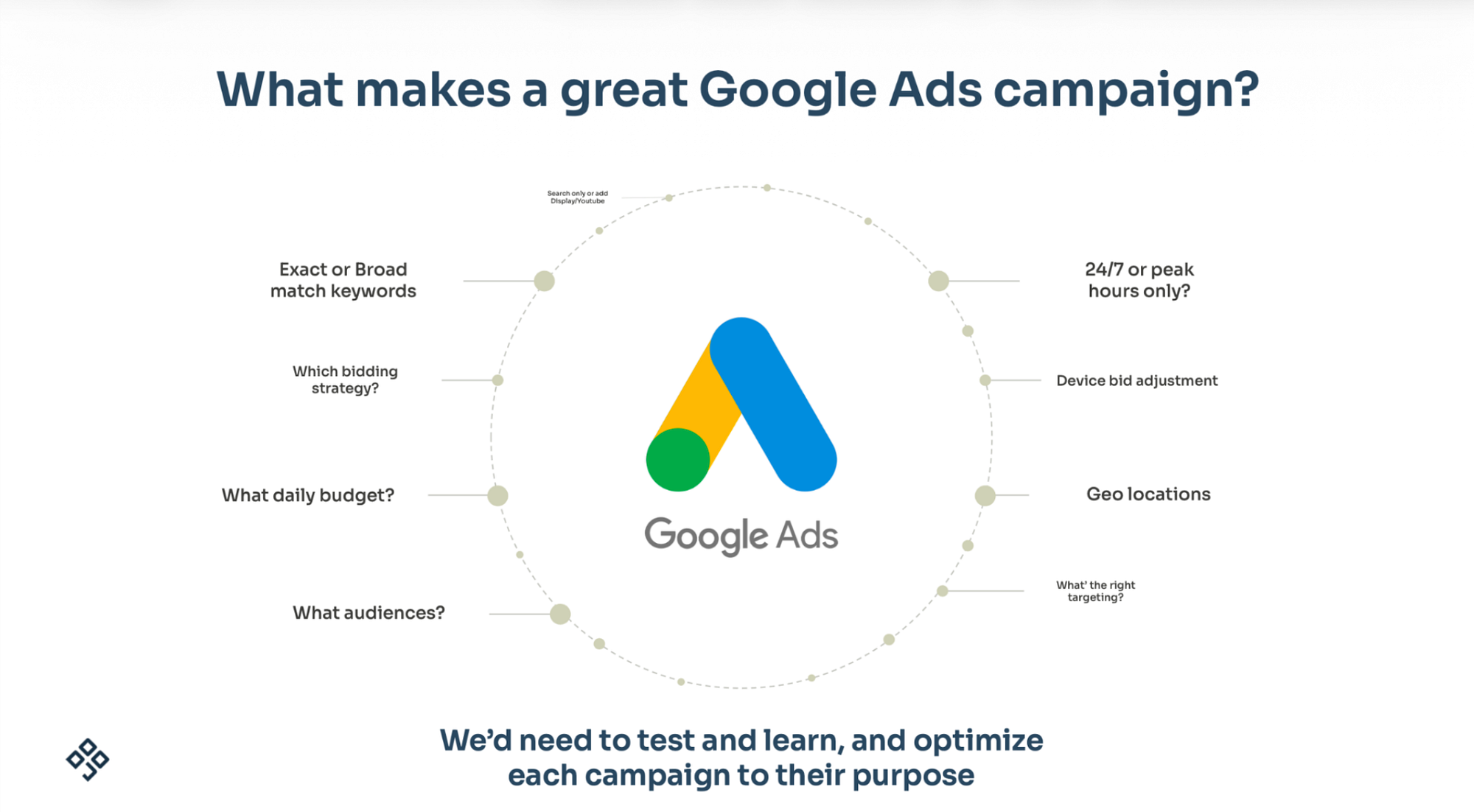
Companies also compete against platform algorithms that evolve continuously and often without notice. Consumer preferences also shift. A campaign configuration that outperformed last month may underperform today.
This forces continuous optimisation cycles. External agencies have largely settled on weekly or bi-weekly review cadences, trying to balance scalability with service quality. But that rhythm creates its own fragility: there is always a window of drift between cycles where performance can erode unnoticed.
To master each channel, companies rely on internal marketers and external agency support. Labour and agencies together account for the largest share of the marketing budget, nearly double the tooling budget alone.
Why general-purpose AI and Agents, on their own, are not the answer
Against this backdrop, recent advances in generative AI and agentic systems look, at first, like exactly what marketing teams have been waiting for. Are they?
In some respects, yes. BCG research shows that marketing teams adopting agentic AI are already reporting meaningful improvements in content output, campaign speed, and cost efficiency. And 81% of marketing teams are already piloting or using AI in production.
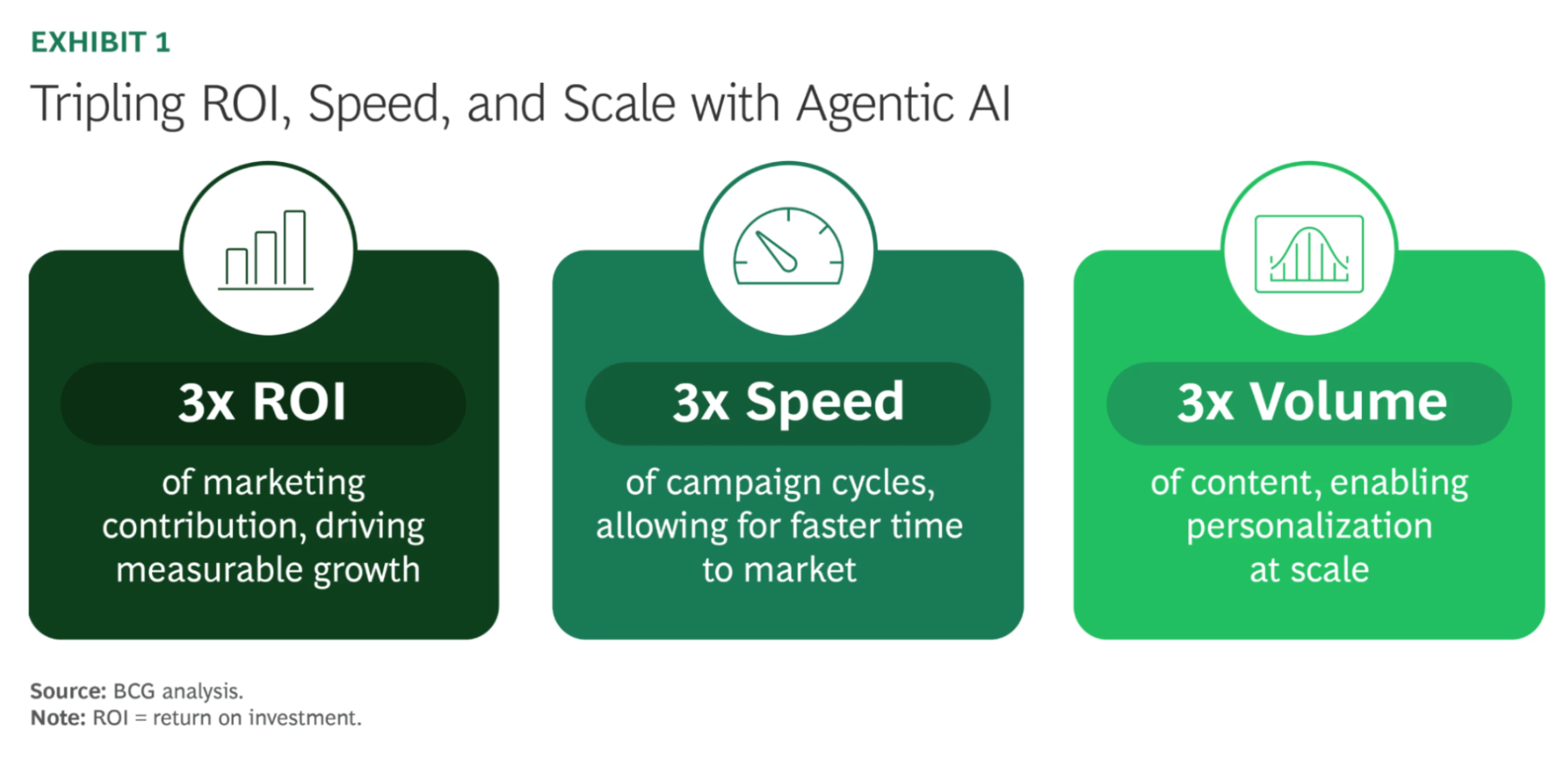
The potential is genuine: analysis that required a dedicated analyst can be automated; content that took weeks to produce can be drafted in hours; audience segmentation that was manual can be made dynamic.
But there is a structural problem that most teams are running into: AI agents are only as good as the context they have access to.
General-purpose large language models are extraordinarily capable. But they are also, in an important sense, flying blind. They do not know what campaigns are currently running, or what they cost. They do not know which keywords the brand ranks for, what competitors are doing this week, or how customers have responded to different messages in the past. Without that grounding, they produce answers that are often speculative and disconnected from the actual state of the business.
In practice, this has limited AI’s impact in marketing to relatively contained, lower-stakes tasks: writing a social post, drafting a subject line, generating a first cut of copy. The high-value work has remained human-led. Not because AI lacks the reasoning capability. Because it lacks the context to apply that reasoning reliably.
The gap is not in the models. It is in the missing foundation.
The data lives in walled gardens, scattered across tools that were never designed to share it. Without a system that consolidates and structures that context, even the most capable reasoning model will hallucinate an SEO analysis. It has no grounded, factual picture of the brand’s marketing reality to work from.
Context, however, is still only half of it. Channel algorithms change constantly, and the best campaign configuration today may underperform tomorrow. Without that feedback loop, agent performance drifts. As tools like Claude Code have shown, agents perform dramatically better when they can verify their own work: running tests, comparing outputs, and self-correcting against observed results.
Some tools are starting to address parts of this in isolation. Jasper and Copy.ai optimise content; Profound and Peeq address AEO and GEO. But they still require strong human supervision, and they each optimise for a single channel or a single step. Some teams attempt to build internal solutions, but these carry their own burden: data plumbing, systems integration, and the ongoing cost of maintaining bespoke infrastructure.
Building a Marketing Intelligence System that integrates context, grounds AI reasoning, closes the feedback loop, and operates across all channels simultaneously remains an unsolved problem.
This is precisely the problem DOJO AI was built to solve.
Enter DOJO AI: an operating system for agentic marketing
What the market has been missing is not more tools. It is a layer that connects and learns from them all: a continuously updated, structured picture of the brand’s full marketing reality that AI agents can actually reason from and act on. Not a dashboard. Not another analytics point solution. A Marketing Intelligence System.
That is the gap DOJO AI was built to close.
DOJO AI integrates with a brand’s marketing and sales stack — Google Ads, Google Search Console, Google Analytics, LinkedIn, Meta, and more — and pairs those first-party integrations with web intelligence, and every user interaction on the platform itself. From that data, DOJO AI builds and continuously updates a proprietary knowledge graph it calls the DOJO Graph: a living digital twin of each customer’s marketing operation and competitive landscape.
When an agent needs to reason about a content strategy, an ad optimisation, or a competitive gap, it reasons against a factual, grounded, continuously refreshed representation of that brand’s actual marketing reality — not a training set from two years ago, and not whatever the user manages to paste into a prompt.
Specialised agents — a Performance Marketer, a Data Analyst, an SEO/AEO Agent, and a generalist co-pilot (Sensei) — execute across the full marketing stack through a conversational interface. A user might ask DOJO AI to evaluate the brand’s position across all channels, identify budget reallocation opportunities in paid search, or benchmark a competitor’s content strategy. DOJO AI researches, analyses, recommends, and creates. The user retains control.

The proprietary Marketing Ontology that underpins the DOJO Graph maps marketing activities and KPIs across every channel and dimension — from share of voice to brand sentiment to keyword ranking to campaign-level ROAS — grounding agent reasoning in facts and semantics.
Accessing context is still only part of the value. DOJO’s data engine closes the loop. Inspired by Andrej Karpathy’s work at Tesla, the data engine tracks every recommendation, every piece of generated content, and every optimisation action against its real-world outcomes. User feedback, campaign results, and channel signals flow back continuously into the system, allowing it to self-correct over time.
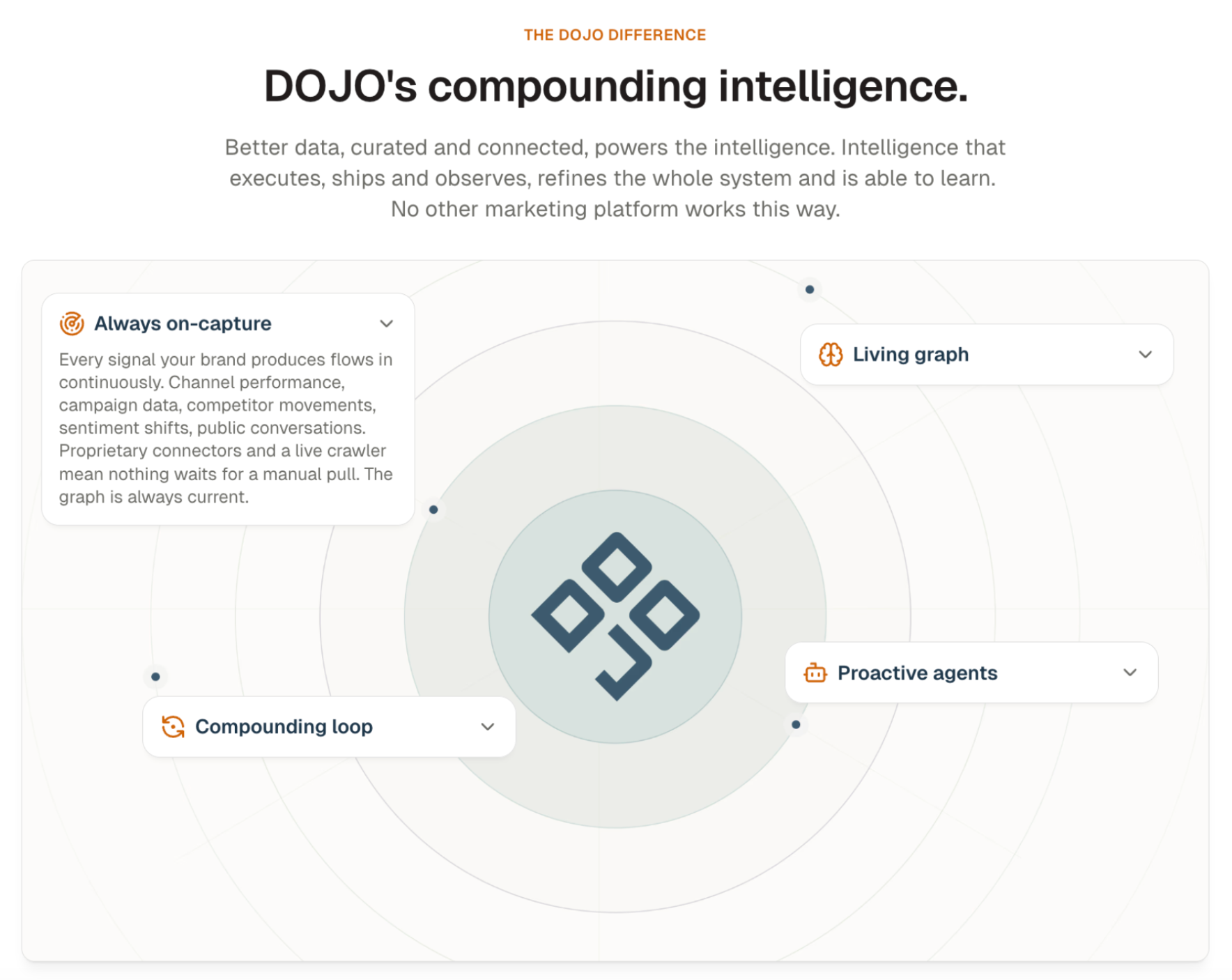
The longer the system runs for a given brand, the more accurately it understands what works in that specific market, on that specific channel, for that specific audience. That compounding advantage is structural. A point solution that optimises a single channel learns about that channel. DOJO AI learns about the brand.
The team: the Sensei behind DOJO

DOJO AI was founded by António Alegria and Duarte Garrido, two people who have been running into this problem from opposite sides of it for the better part of a decade. They are also long-time friends, having grown up in the same circle in Lisbon. That is not a happy accident in a pitch deck. It is the reason DOJO exists.
Duarte, after an earlier career spanning professional cooking and media production, spent almost 10 years in marketing roles at global corporations and startups: Sky, Coca-Cola, Standard Chartered Bank, Volt.io. That experience gave him direct, repeated exposure to the fragmented tool stack, the disconnected data, and the gap between analysis and decision that DOJO AI is designed to close.
António spent over a decade at two Armilar portfolio companies, both of which went on to become unicorns. First at Feedzai, an AI-native financial crime prevention platform, as a Machine Learning Engineer and Product Leader responsible for building the core platform, and later the Cloud product. Then at OutSystems, a software development platform built for the enterprise, as Head of AI. Those roles gave him direct, compounding knowledge of how data pipelines and closed feedback loops can be built to improve over time.
In 2023, he left OutSystems to build the foundational technology, initially for a horizontal use case. The focus on marketing came when Duarte reached out. Together, they interviewed more than 100 marketers to confirm the fit between the problem and the solution.
Why we invested in DOJO AI
We have been in touch with António since 2023, intrigued by the technology stack that he was building and the types of problems that it would help solve. When he joined forces with Duarte, focused on the marketing function, and the product began to find its footing with early customers, we started paying close attention. What we heard from those customers was not about features. It was about outcomes: 3x increase in ad conversion volume, while acquisition costs fell; partners’ pipeline growing 67%; content output tripling, with the same team and no decline in quality.
Today, over 100 brands primarily in the U.S. and U.K. use DOJO AI, including CoinDesk, PensionBee, Morningstar, Employment Hero, Amplemarket, Broadvoice, CovertSwarm, FreshTri, and Refine Labs. We, at Armilar, are also users of the product, and that made the decision to invest even easier.
But what ultimately convinced us goes beyond traction. There were four things we kept coming back to:
- The right technology, built from the ground up. The DOJO Graph is not a dashboarding layer or a thin wrapper around a language model. It is a knowledge graph designed from first principles to ground AI reasoning in a brand-specific, continuously updated picture of marketing reality. The data layer and closed-loop system ensure a continuous learning cycle, connecting context, recommendations, actions, and outputs. The data compounds the longer the system runs.
- A founding team with the exact experience this problem demands. António built closed-loop learning systems at two unicorns. Duarte lived the fragmented tool stack from the inside, for a decade, at global brands. This is a rare case of genuine founder-market fit on both the technical and operational sides simultaneously.
- A large, structurally fragmented market with no adequate incumbent. MarTech spending exceeds $500 billion globally. Every major platform is isolated. No existing solution integrates, learns, and acts across the full stack. The fragmentation is not a temporary gap; it is the structural condition that makes this category both necessary and durable.
- A distinct category, not just a better point solution. Most AI marketing tools optimise one channel or automate one step. DOJO AI is building a different category entirely: a Marketing Intelligence System that learns the brand across all channels simultaneously. That is a harder problem, and a harder thing to replicate.
Behind this investment sits a broader conviction: agentic AI systems are giving every business function the ability to reason, act, and learn continuously across entire workflows — compressing into minutes work that once required entire teams, and bringing systematic intelligence to decisions that were previously made on instinct and incomplete data. Finance, sales, operations, marketing: every department is facing the same defining moment. Workflows built over decades are being redesigned from the ground up. But the hard part is not injecting a general-purpose LLM’s fantastic reasoning abilities into an existing workflow — it’s to rethink the workflows going back to the first principles to leverage those new capabilities that have become widely available and build something much more powerful; this requires a deep domain expertise and a tech stack to match it, accurately reflecting the field’s ontology and evolving with each interaction. Marketing, with its fragmented data and channels, its competitive and dynamic environment, and its chronic gap between insight and action, is one of the most compelling places to start.
The challenges ahead
What DOJO AI attempts to accomplish is hard. The bar is high.
The marketing AI space is one of the most crowded segments in enterprise software. Every platform that has ever touched a marketing workflow is relabelling itself as an AI agent. Companies like HubSpot, Salesforce, and Adobe have the distribution and the engineering resources to pursue adjacent versions of this thesis, and they are pursuing them.
Claiming “we connect the stack” is easy. Building the infrastructure that enables a powerful marketing digital twin, and creating a flexible and performant agentic system on top of it, is a different challenge entirely.
There is also a harder question about moat defensibility. Models are getting smarter. Model companies are beginning to move into the application layer. The question of where value accrues in an AI-native stack is genuinely open.
Our hypothesis is that, even with significantly more capable models, value will accrue to whoever controls the marketing end-to-end workflow — and consequently the continuous context, actions, and performance data — across a growing base of companies. This is particularly true in an dynamic environment where campaign data is not public for models to train on. DOJO AI is the data and learning infrastructure — a Marketing Intelligence System. And it gets more valuable with every interaction.
We are convinced DOJO AI can define the Marketing Intelligence System category. As the team uses the $6M Seed to strengthen its multi-agent capabilities, deepen its continuous learning infrastructure, and accelerate growth in the U.S. market, we are thrilled to join them on this journey.
Article written by Pedro Almeida, Principal at Armilar, with the support of Sensei, DOJO AI Agent.