Why Armilar invested in Trendtracker… and a few insights on strategic intelligence in the AI era

The world is changing faster than ever. The average tenure of S&P 500 companies has shrunk from 30–35 years in the 1970s to just 15–20 years in the past decade [1]. Meanwhile, global data volume continues to explode: 181 zettabytes created in 2025 compared to just 9 in 2013 [2]. For corporate strategy teams, this creates a paradox: the need for fast, informed decision-making has never been greater, yet the sheer volume of information makes it harder than ever to identify what actually matters.
Traditional strategic planning cycles annual or quarterly deep dives into market analysis, competitive positioning, and trend forecasting simply can’t keep up. By the time a strategy team completes a months-long research process, the landscape has already shifted. Weak signals that should have triggered early action get buried in noise. Strategic blind spots emerge not from lack of effort, but from information overload.
As a result, companies invest enormous resources into strategy functions that are overwhelmed, reactive, and often looking in the rearview mirror. Analysts spend weeks manually scouring news sources, research reports, and industry publications to piece together trend analyses that are already outdated by the time they reach executive teams.

A horizon scanning exercise is a structured, typically periodic activity led by strategy teams to identify early signals of emerging trends, risks, and opportunities that could shape future decisions. While an important input to strategic planning, it is often time- and resource-intensive, subject to bias, can age quickly, and usually covers only a defined subset of potential developments
The rise of strategic intelligence platforms
This problem is driving rapid growth in a new category of software: AI-powered strategic intelligence platforms. The strategy management software market was valued at $5.2 billion in 2023 and is projected to reach $14.5 billion by 2033, growing at 10.8% annually [3]. The adjacent competitive intelligence market is growing even faster at 13% per year [4].
But existing solutions fall short:
- Traditional market intelligence providers (e.g., Gartner, GlobalData, S&P Global) offer static reports and datasets. You can read what analysts wrote three months ago, but you can’t surface emerging trends in real-time or get answers tailored to your specific strategic context.
- Media monitoring tools (e.g., Meltwater, Brandwatch, Signal AI) track mentions and sentiment based on volume. They tell you what’s being talked about now, based on volume and frequency. But popularity doesn’t equal strategic relevance. These tools are great for PR and brand monitoring but lack the depth to assess long-term trend maturity or business impact.
- Innovation management suites(e.g., HYPE Innovation, ITONICS) help companies manage idea pipelines and stage gates. They might include basic trend radars, but these rely heavily on manual input and curation. Trends are an input to the process, not the focus.
- Foresight tools (e.g., Futures Platform) take a long-term view, often anchored in human expert analysis. They’re valuable for big-picture thinking but not designed for the speed and scale that modern strategy teams need.
What’s missing is a platform that combines the depth of strategic foresight with AI-powered automation: one that identifies weak signals, assesses trend maturity across industries and geographies, and connects insights directly to strategic priorities.
Why strategic intelligence is hard to automate
Building a truly useful strategic intelligence platform is hard. The challenge isn’t just technical, though the technical hurdles are significant. It’s that strategy work is fundamentally about context, judgment, and connecting dots across disparate signals. A good strategy analyst doesn’t just read news articles and count mentions. They understand industry dynamics, recognize patterns, assess the credibility of sources, and synthesize insights that are relevant to their organization’s specific situation.
How do you teach a machine to do that?
You need to:
- Ingest massive amounts of data from diverse sources. Not just news, but academic research, patents, regulatory filings, industry reports.
- Classify and structure unstructured information using natural language processing that goes beyond keyword matching to understand context and meaning.
- Score trends not just on volume but on maturity and relevance, distinguishing between fleeting hype and substantive shifts.
- Provide transparency and explainability, because strategy decisions involve real risk and executives need to understand the “why” behind insights.
- Tailor everything to organizational context: the trends that matter for an Asian financial institution are different from those relevant to a European football association.
- Identify and analyse strategic options, produce well-grounded actionable recommendations and assist strategic decision making.
Most platforms pick one or two of these and do them reasonably well. Few attempt to do all of them. Even fewer succeed.
Enter Trendtracker
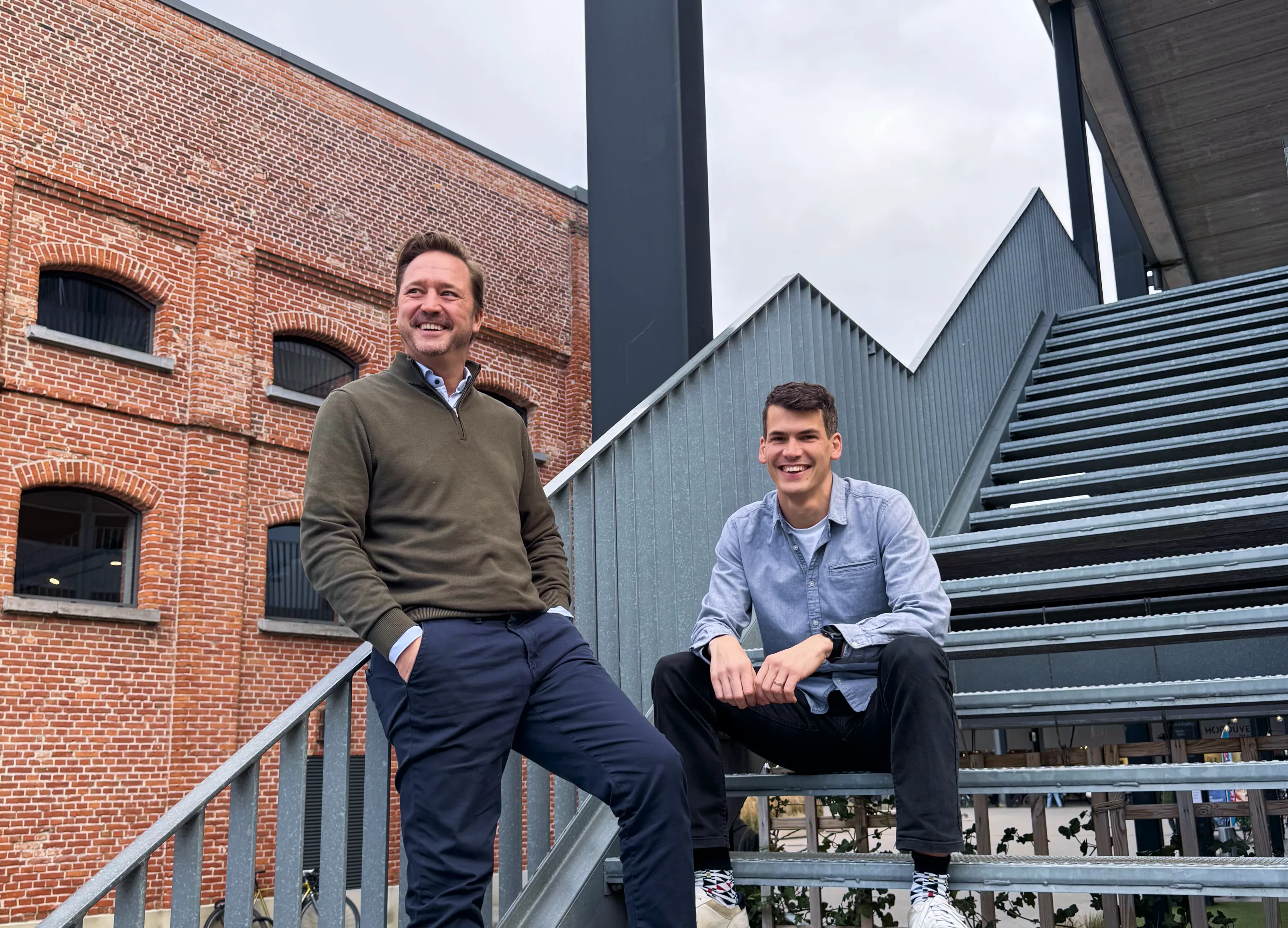
Vincent Defour and Mathias Colpaert didn’t set out to build just another trend monitoring tool. Vincent spent over a decade in strategy consulting, working with enterprises on transformation projects. He saw firsthand how much time analysts wasted on manual research that should be automatable, and how often companies missed early signals because they were looking in the wrong places or simply overwhelmed by information volume.
When he teamed up with Mathias, a software engineer with strong technical depth, they set out to build something different: an AI-powered strategic intelligence platform that could do the work of an analyst team — continuously monitoring, scoring, forecasting, and interpreting trends — but at machine speed and scale.

Founded in 2019 in Ghent, Belgium, Trensition (the company behind Trendtracker) spent several years in heads-down product development, building the technical architecture needed to deliver on that vision. They raised a Seed round in 2022 from Capricorn Partners, along with several grants, and focused on getting the product right.
The result is Trendtracker: a platform that ingests data from over 18,000 sources, applies proprietary NLP and machine learning models to identify and score trends, and delivers contextualized insights through an intuitive interface that feels less like a database and more like a strategic sparring partner.

Spotting emerging shifts early: Trendtracker’s AI surfaces signals from billions of global data points, giving enterprise teams a strategic edge on emerging disruptions, with prioritized recommendations tailored to each industry.

Making sense of complex change: teams receive personalized strategic advice powered by Trendtracker’s proprietary predictive AI engine, delivering deeper scoring, forecasting, and strategic recommendations than general-purpose LLMs or generic internet sources.


Track trends in real-time: Trendtracker allows organizations to stay ahead, not just updated, by tracking how trends evolve over time.
At its core, here’s what sets Trendtracker apart:
- Multi-dimensional trend scoring. Most tools track mentions over time. Trendtracker goes several layers deeper. Its proprietary Trend Strength Index (TSI) algorithm scores trends not just on frequency, but on where mentions appear (headlines vs. body text), which sources are covering them (leading industry publications vs. general news), and how the conversation is evolving across different business contexts. The system organizes data sources hierarchically by subject, prioritizing high-signal sources and filtering noise to produce normalized scores that enable meaningful comparison.
- Always-on intelligence. The platform runs 24/7, using coordinated AI agents that continuously detect, score, forecast, and interpret trends while preserving context over time. Thus, the system understands not just what’s happening now, but how trends have evolved and what that evolution suggests about future direction.
- Transparent and explainable. When Trendtracker surfaces a trend, it shows the underlying data: which sources drive the signal, how the trend evolved, what industries and geographies show activity. You can drill down into the reasoning behind every insight. This is crucial, as strategy decisions carry real weight. Executives need to understand why a trend is flagged as important, not just trust a black-box algorithm.
- Contextualized insights. A trend that’s critical for an insurance company might be irrelevant for a consumer packaged goods business. Trendtracker doesn’t give you generic trend reports — it tailors insights to your industry, geography, and strategic priorities. Clients use the platform to build custom “trend boards” focused on their specific areas of interest. The AI learns from these boards, recommending related trends and surfacing connections that might not be obvious. Over time, the platform becomes more valuable as it develops a richer understanding of what matters to your organization.
- AI-driven strategic intelligence. Trendtracker is evolving from descriptive trend analysis into prescriptive strategic intelligence by combining external signals with internal company data. The roadmap includes AI models that recommend strategic actions aligned with a company’s goals and constraints, as well as scenario-planning and forecasting tools that let teams simulate how future trends may unfold and assess their potential business impact.This expands the platform from answering “what’s changing?” to helping leadership teams reason through “what should we do about it?” and “what happens if we’re wrong?”
Since launching commercially in 2023, Trendtracker has built a client roster that validates both the product and the market need, including enterprise clients such as PepsiCo, Procter & Gamble, Siemens, Ageas and BNP Paribas, top-tier consulting firms (e.g., PwC, Arthur D. Little), renowned global investment firms, and several government and public sector organizations across Europe and Asia.
Equally importantly, usage patterns show real stickiness: clients continue adding new trends to their boards over time, and many are already exceeding their contracted usage levels and expanding across different teams.
Equally importantly, usage patterns show real stickiness: clients keep adding new trends to their boards over time, with many already exceeding contracted usage and expanding beyond the core strategic planning team. As adoption grows, the platform naturally spreads across the organization, becoming a valuable tool for product, technology, risk and other operational teams that wouldn’t typically engage with strategic intelligence software.
Use cases span a broad strategic spectrum, including:
- Horizon scanning for insurers and investment firms monitoring long-term risk
- Technology scouting for industrial companies tracking emerging tech that could disrupt their operations
- Risk sensing for multinational corporations monitoring geopolitical and regulatory trends
- Strategic decision support for executive teams needing real-time intelligence to inform major moves

Why we invested
We’ve been tracking the strategic intelligence space for a while (not surprisingly, as many of us in the investment team are former strategy consultants), and we kept coming back to the same question: why hasn’t someone built the modern version of this yet?
When we met Vincent and Mathias, it became clear they were actually doing it. Not just talking about it, but building it: methodically, technically rigorously, and with deep respect for how hard the problem actually is.
A few things stood out:
The technical architecture is real. This isn’t a thin wrapper around [insert general-purpose LLM of choice]’s API. Trendtracker has built a multi-layered system that combines NLP, topic modeling, time-series analysis, and proprietary scoring algorithms. They’ve developed efficient methods for storing and querying scored documents, and patented them. More importantly, they’re building a defensible data moat through curated source hierarchies, structured scraping of high-value content, and feedback loops that improve the system over time.
The team knows what they’re doing. Vincent brings deep strategic consulting experience and understands the customer intimately. Mathias has built a solid engineering team and product development process. The company is disciplined, focused, and realistic about what it takes to scale: they’re not overpromising or trying to boil the ocean.
The market timing is right. Advances in AI are making strategic intelligence automation possible in ways that weren’t feasible five years ago. At the same time, growing global uncertainty is pushing enterprises to invest in tools that help them move faster and make better decisions. Trendtracker sits at the intersection of these trends.
Early traction proves product-market fit. Getting PepsiCo, PwC, and Siemens (to name a few) as customers when you’re a ~15-person startup in Ghent is not easy. It means the product works, the value proposition resonates, and there’s real willingness to pay. The strong growth and expanding usage within accounts suggest this isn’t a nice-to-have tool: it’s becoming essential to how these organizations do strategy work.
The outcome potential is significant. If Trendtracker executes well, it has the potential to become a category-defining platform in strategic intelligence.
But the bar is high. The strategic intelligence market is fragmented and competitive, with well-funded players and deep-pocketed incumbents. Trendtracker will need to continue proving that its approach (AI-first, product-led, technically rigorous) can win against both traditional data providers and newer entrants.
But we believe they can do it. The product works, the team is strong, the market is ready and the early traction speaks for itself. The new funding gives them fuel to scale.
Authored by Pedro Castel-Branco, Armilar
References
[1] Innosight (2025). “Creative Destruction: The Average Lifespan of S&P 500 Companies.” https://www.innosight.com/insight/creative-destruction/
[2] Edge Delta (2025). “Data Market Size and Forecast.” https://edgedelta.com/company/blog/data-market-size-and-forecast
[3] Data Horizon Research (2025). “Strategy Management Software Market Analysis and Forecast.” https://datahorizzonresearch.com/strategy-management-software-market-38899
[4] Verified Market Reports (2025). “Competitive Intelligence Software Market Report.” https://www.verifiedmarketreports.com/product/competitive-intelligence-software-market/